Showing posts with label Community Building. Show all posts

Wednesday, June 27, 2012

2 reasons why the Panera Cares Cafes is great for our community and 1 reason why it’s transcendent


When I first wrote about the Panera Care's Cafe, it was a surprising new venture.  

Now it's getting less surprising and more the norm.  Which is a wonderful development.

The best thing about Panera opening Illinois’ first Panera Cares Café (and the fourth nationwide) in our community isn’t that many down-on-their-luck people in Chicago will be able to eat a good solid meal every day, and possibly have just a bit more energy or inspiration to make one more phone call and get that interview that could lead to something good.

That’s pretty great, but it’s not the best thing,

It’s not the wonderful and amazing fact that Panera is leaning on the community to do what it’s successfully done in Clayton MO, Portland OR, and Dearborn, MI:  strike a balance of providers and acceptors in shared responsibility that Panera founder Ron Shaich calls “not a hand out, but a hand up.” 

But that’s not the best thing either.

The best thing about the Panera Cares cafes is that they’re turning a profit. 

Which means that other QSR’s might look at them and say, “Hmmm.  Maybe we should be doing that too.”

Now that would be the best thing that could come out of the success of the Panera Cares Cafes.  Stop by the new one at 616 W. Diversey, come join this important community, and see if you can personally help them strike the right balance.

Monday, June 25, 2012

How a community can make you smile broadly, get tingly, maybe even shed a tear


I moderated a panel at techweek on Friday.  We had some great insights from our panelists and terrific audience Q&A.   Some great stories about the power of people to connect with each other and become massive and powerful forces for good and commerce. 

Then I heard something on the radio yesterday morning that put a massive exclamation point on it.

Bob Edwards interviewed Eric Whitacre, a musician, composer and conducter, who has written music for, and virtually led—that is, online—a choir of over 2000 people.

If you love music, watch and listen.  It’s one of those tears-of-happiness things.

The story of how the virtual choir gained momentum is wonderful inspiration for anyone with an idea waiting to explode.  The endeavor is impressive and the music is beautiful. 

But what’s most impactful is hearing how the community that formed itself through Mr. Whitacre’s virtual choir has come together.  Not just to sing together, but to support each other.  They’ve formed a community that communicates virtually; they even experienced the first death last year of one of the community members.

In Whitacre’s words, it’s their shared intent that ties them together and “takes them to a transcendent place.  It’s not just a virtual choir anymore, it’s a virtual choir army.”

It proves the simple  and lovely fact that humans will go to any lengths necessary to connect and communicate with each other and once they do, the communities they form are incredibly powerful. 

How they form isn’t hugely different from how great ideas often come to life:  a combination of pluck, luck, skill, and timing.  And shared intent.

The guiding force of a strong community is a common passion, and humans with a strong shared intent can’t be held back. 

Tuesday, June 19, 2012

What Ronnie woo-woo can teach us about branding


At the Cubs game the other night, there was a  vendor who used mystical powers to get people to pay five bucks for a bag of peanuts. 

I know this because in a sea of “Beer Here!” and “Hot Dogs!” cutting through the calm night’s air, this vendor barely said a word.  When she did, you could see her lips form the words “peanuts,” but almost no sound came out.

She was no younger than 70 and no taller than five feet; her ID tag read “Ho Pun.”  Her face was weathered as if she’d spent 50 summers at Wrigley Field but I’d never seen her before.

She would walk halfway down the aisle and hold up a bag of peanuts and stare at someone until the person bought a bag of peanuts in hopes of basking in her otherworldly glow, or looked away in fear of being given an underworldly curse.

I don’t think she sold a ton of peanuts, but there was a weird aura about her that made me think that she cared less about her final tally and more about her purpose.

Speaking of which, Ronnie Woo-woo was also there, walking the aisles, dancing, smiling, taking pictures.  But not woo-wooing.  Not a sound came from his mouth.

Has he woo-woo'ed so much that he's damaged his vocal chords?  Is he out of woo’s? 

Or did he find some meditative place that told him not to speak, only to radiate.  Send out positive vibes and assume they’ll return.  It certainly didn’t affect the number of people who wanted to hug and dance and take pictures with him.

There are a couple of lessons in Ho Pun and Ronnie Woo-woo’s approaches.  One,  there are many different ways to differentiate your brand, and being loud doesn’t always have to be one of them. 

And two, sometimes worrying about the end result gets in the way more than you might think.  Think about what you’re doing and how you do it, not where it’s going to end up.   And somewhere in there, smile or dance.  Or look someone in the eye with the most direct intention you can muster.  You never know what they’ll give you.

Monday, June 4, 2012

Building a community one traveler at a time


Our last post talked about Oliver Samwer and his marauding band of idea stealers.   One of those ideas is airbnb.

Crashing in someone’s pad used to mean you had no dough.   Now it means you’re on the fun, progressive, pennywise edge of travel.

If you think Airbnb (and all of it’s countless imitators) is successful because people can comfortably stay in big cities across the world for far less than big city hotel prices, you’d be right.

If you said it’s also successful because visitors get to see interesting unexpected neighborhoods and enjoy the quirky comforts of artsy (and sometimes downright crazy) apartments, you’d also be right.

But the key insight you may be missing is a craving for community in a digitally fractured world.

So much of what we do happens in the ether between faceless people with handles instead of names.  Any chance we can have to connect face to face with a stranger who becomes a real-world friend is invaluable.  That’s why staying in youth hostels made European travel that much more special.

Airbnb brings this benefit to life.  It enables two people to sit over coffee and talk. Make a connection.  Start to buold community.

Ironically enough, it’s all due to technology, beginning with a simple, brilliant idea, brought to life as only the internet could, sparked by one of the greatest of all travel-related questions:

Can I crash in your pad?


Wednesday, May 30, 2012

Make your ideas brilliant and unique. Oliver Samwer is watching.


One of the best things about the digital world is that it fosters ideas.  

If ideas were democratic before the internet, now it’s as if they grow on trees, just waiting to be plucked by the next ballsy entrepreneur who leaves college to become a multigazilionaire.  

It’s today’s version of  Bill Blazejowski, who constantly dictated his ideas into a tape recorder (“What if you mix the mayonnaise in the can, WITH the tunafish? Or... hold it! I got it! Take LIVE tuna fish, and FEED 'em mayonnaise!”).

Today, the tape recorder is the internet, the mayonnaise is an accomodating VC, and up pops another amazing, creative, functional, lucrative idea.

My old boss, who said that there are only seven original ideas in the world, has been proven wrong again and again.

Although Oliver Samwer might agree with him, he of the deceptively peaceful blue eyes above.

Mr. Samwer steals ideas for a living, clones and repackages them, and makes billions doing it.  He plays by the rules and does things legally.   He has no reservations and makes no apologies.

And he often makes an idea better, through design, packaging, promotion; the wrapping that we all see. 

So the lesson for all of us crazy hopeful dreamers with the next Big Thing rolling around in our heads:  

If your idea is brilliant enough, Oliver Samwer will want it too.  Make your idea smart and strategic, and make it bulletproof.  Think it through, take your time, and make it thorough. Cover as many bases as you can.

And most of all, make it as unique as possible.  The more unique you make it, the more people will want YOUR version of it.

And raise as much mayonnaise as you can.

Tuesday, February 28, 2012

The single best fast food restaurant in the history of the world, ever


“Give the people what they want” is and always will be a relative concept, because not everyone wants the same thing (unless you’re in prison awaiting execution, in which case, I’ve heard cheeseburger and fries is pretty much the standard). Nowhere is that more true than in the world of QSR’s (aka Fast Food).

There’s Chipotle, my personal favorite, who goes out of their way to show their dedication to their fans, offering extremely high quality, fresh food, and topping it off with their Cultivate festivals highlighting healthy, locally sourced food (and music).

Sadly, there’s, KFC, whose Double Down (1380 mg of salt) set healthy eating back to a time when men were men and Doctors smoked in their examination rooms.

But happily, there’s Panera, who has more than made up for KFC’s artery-clogging abuse of humankind with their Panera Cares Cafes. What makes these Paneras special? You pay what you like.

Prices are posted, and when you order, you’re told what the full cost would be; you can pay what they ask for, or you can pay more. And most important, you can pay less—even nothing.

This is a brave, audacious, wonderfully twisted idea. No doubt, it’s inspired by our nasty economic situation. Kudos to Panera for having the guts to do it, and after a successful trial run, they’re opening up more.

A good old friend of mine always liked to say that Confidence = Generosity and there’s truly nothing more confident than giving something away, whether it’s something you can hold in your hand like a sandwich, or something you can pass on that creates value for others, like a great idea.

For better and worse, America is the home of giving people what they want. So you can cram bacon, cheese, and fried chicken into the stupidest most unhealthy sandwich since the Earl put meat between bread, and get people to like you for a little while, or at least until the saturated fat overtakes their limbic mode and they forget they ever ate it.

Or you can give people trying to get back on their feet the opportunity to have a meal once a day, so maybe, on that day, he or she will have the physical and mental energy to make that one additional call and get that interview s/he’s been hoping for, and who knows what could happen from there.

Those people aren’t just your customers. They're potential members of your community, ready to spread the gospel of what you do. It's a great lesson for any person or marketer and whether you're trying to do business or just lead an upright life, it's powerful stuff.

Tuesday, February 21, 2012

Consider the community-building power of a kidney


What’s the most powerful organ in your body? From a community-building standpoint, I’d have to say the kidney.

To back up a step:

Other than religion and the Tea Party, there may be nothing that ties people together as passionately as experiencing a medical challenge or tragedy. Breast Cancer Walks and Relays for Life are two very visible examples, but across the world, people form communities that start in sadness. So it’s a wonderful thing when they end in celebration.

And so it was with Chain 124, an incredible story of kidney donors and recipients.

You can read the New York Times story, but in a nutshell: 30 people gave kidneys to 30 people they didn’t or barely knew, but who were in danger of dying without a new kidney. Through the blindly selfless acts of the donors, kidneys were flying all over the country across four months, 17 different hospitals, and 11 states.

The donors and recipients may not be inviting each other over for drinks any time soon, but come Thanksgiving, I’m betting there will be a few extra places set at the table. I can’t think of any more powerful way to bring people together. Consider how good it would feel to participate and check out what you can do.

And the next time you say, “I’d give up a kidney to (fill in the blank),” be prepared to give up a kidney.

Friday, February 17, 2012

What Michael Jordan, Jeremy Lin, and Kim Kardashian can tell us about community building


As a responsible recorder of human progress and an authority in community building, I’d be remiss if I didn’t write about Jeremy Lin.

Tough to pen something new about him, but how about this: If he removed the second and third syllables from his first name, he’d sound like a country superstar, maybe the long lost Taiwanese stepchild of Loretta Lynn?

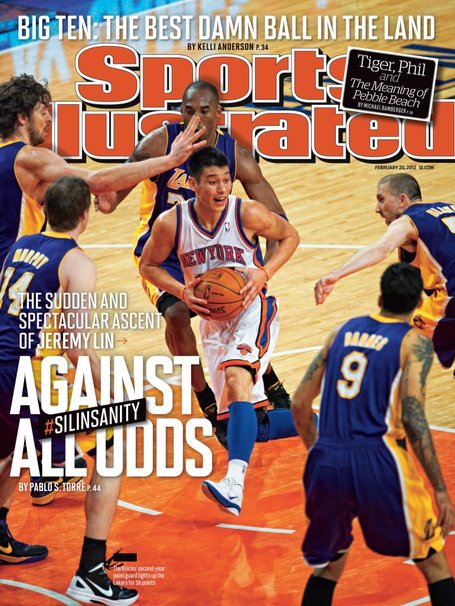
Even that wouldn’t approach the level of superstardom Lin has achieved in his three-week ascension. Sports Illustrated cover (the jinx hasn’t happened yet), ebay madness, even rumored dates with Kim Kardashian, a member of a family that apparently can’t get enough NBA players in their lives.

To me, the most amazing thing has been the community of love and support that has grown around him. Granted, his is an amazing Cinderella story, but without the power of social media—last week he hit 2.6 million times on Twitter, more than LeBron, Kobe and seven other NBA elite players combined--there might not have been any $40,000 jersey sales or potential Kardashian Koupling.

For the most part, the explosion of the Jeremy Lin community isn’t a very good lesson for marketers when it comes to building communities for their brands, because of the uniqueness of the situation. But one thing you can learn:

There’s nothing like the combination of success, humility, and a great smile.

Just ask today‘s birthday boy. You know who I'm talking about...

Wednesday, February 1, 2012

Join a community, win millions! (or not)


It’s true that communities can help brands become commercial powerhouses and money-making machines. But it takes investments of time and money. It must be a steady, strategic, nose-to-the-grindstone approach that rarely happens overnight.

Or not.

This is what makes Sodeta, Spain an anomaly. Because every person in that town of 70 households, except one, recently went from poverty to wealth after winning Spain’s famous Christmas Lottery. It's a great story.

Some won millions, and even the least fortunate hauled in $130,000.

Then there’s Costis Mitsotakis.

He was the only person in the village who didn’t buy a ticket. So now he lives as proof that when a community is doing something together, best to jump in while you can before you’re driving your Yugo in a parade behind a bunch of McLarens and Bentleys.

Which won’t happen in Sodeta, where life is now merely filled with more card-playing leisure, and some of the more extravagant purchases have been a patch of land and a sofa. Sounds like this community is going to stay together for some time.

Monday, January 23, 2012

JoePa: When a loss is a gain


In football, there are times when a coach instructs an offensive player—usually the quarterback—to go backwards, that is, take a loss in yardage. The ballcarrier might run through his own end zone to record a safety to protect a large lead while the clock runs out, or run backwards a couple of yards towards the middle of the field to give a kicker a better angle for a field goal.

After 46 years as the Head Coach of Penn State University football team, Joe Paterno knew when it was time to take a loss on the football field. But unfortunately he couldn’t transfer that know-how into real life situations, and ultimately it cost him everything: His job, his dignity, and most likely, his life. Because it’s obvious now that his job was his life. He just couldn’t live without being the coach.

In the months since the horrible allegations against Jerry Sandusky were dug up and then blown up, the dynamics of the community surrounding Coach Paterno and Penn State has ebbed and flowed, starting big and strong but shrinking as more details were revealed. And now, with his death, the community can’t help but grow again.

Even the people who felt anger and disgust for Coach Paterno and his program when the Sandusky story developed, while still repulsed, couldn’t help but feel tremendous sadness for Coach Paterno and the amazing things he accomplished. Not only did he wind up as the all-time leader in coaching wins, bowl appearance and bowl wins, Penn State was time and again rated #1 in graduation rates for their football players.

So now many of the same commentators who skewered Coach Paterno just weeks ago are spending at least a little time admitting that the larger picture paints him as a pretty incredible guy. In light of everything he accomplished, it’s hard to be angry now that he’s gone.

Crowds of his supporters lay flowers and memorabilia at his statue and stare at the bronzed feet of the coach they loved, trying to figure out exactly how they feel about him.

Unfortunately, those people might still be cheering him and he might still be Coach if he realized a long time ago what it took his death to prove: that a community may be strongest when it has something to overcome. It’s a powerful lesson for anyone in the business of building one.

Wednesday, January 18, 2012

The one thing every brand has to do every day.


Create Belief.

Chipotle fans have it.

Apple fans have it.

Obama supporters had it in 2008.

Cubs/Packers/Red Wings/etc fans have it.

All great brands have it. It’s the single solitary most powerful reason why people are brand loyal.

And when you have it, you have gold.

Belief why the most loyal supporters are called fans.

Short, of course, for fanatics.

It comes from great service, product design, taste, philosophy. A series of experiences that a person has with a brand that embeds in that person an unwavering belief bordering on love.

That love is so deep, brands could probably slack for a while and still maintain it. But they won that love by never slacking. So it’ll never happen.

Belief is the rock solid foundation of community. It’s as true for every modern religion as it is for Harley Davidson and Four Seasons Hotels.

How do you earn belief? Stay tuned.

Sunday, January 15, 2012

Beefy Fan-Antics


How is fan-dom formed? So many ways.

Some people pass it down in the genes.

Some marry into it.

Some find it along the way.

For any brand with true fans, there’s no one way. My grandpa made me a baseball fan, but he rooted for the Cubs and Sox, and I gravitated to the North side. My son got it from me. I have a nephew who got it by living in Wrigleyville, but we’re all diehard Cubs fans.

Many many many of those diehard Cubs fans gathered over the weekend at the annual Cubs Convention. A larger group of more optimistic yet skeptical fans, you’ll never find.

It was reported in various media sources, cynically by the Chicago Sun-Times, analytically by the New York Times, and respectfully by WGN. None of that was surprising.

These fanatics make me think of another group of fanatics: Chipotle lovers.

Chipotle has done a phenomenal job of creating a brand with a distinct POV and personality, which, combined with good quality, inexpensive food, has created a loyal gathering and, dare I say, a community. Check out the pictures on their Fan-Antics page.

You’ll see pictures of babies in Chipotle gear, brides and grooms feasting on burritos, and those from the elderly set as well. All indications, if you follow the sports model, that Chipotle has truly created a community of loyal devotees.

Somebody tell Theo. Maybe be can get them to sponsor the new scoreboard.

Wednesday, January 11, 2012

The simple, old school secret behind Pinterest


Pinterest is white hot. Everyone is Pinterest-ing, covering pinboards with pictures of chicken parmesan, Reese Witherspoon’s hairstyles, and cats kissing rabbits.

Jewelry, home décor, vacation photos…pure fluff, right? Digital masturbation.

Think again. What some would call a massive waste of time was just given $26 million by venture capital firm Andreessen-Horowitz to play with.

But it’s not a fun little site just for playing around. To start with, here are some interesting thoughts on how to use Pinterest for small businesses.

Most important, Pinterest is becoming a great example of a successful self-curating community. So of course, everyone is speculating about the reasons for Pinterest’s massive success. The best combination of clear and complete came from Elad Gil.

But I’ll boil it down even further. Here’s why:

Spirograph, Play-Doh, Silly Putty.

These classic toys are just three examples of how folks enjoyably occupied their time back in the pre-internet days. Doesn’t get much more analog than that, but they were pretty revelatory when they came out.

Ridiculously successful, each one shared three basic qualities:

It’s fun, it’s easy to use, and it looks cool.

So is Pinterest.

Will Pinterest have the same longevity? Only time will tell. But Google, Youtube, and Facebook also share those three qualities, and their futures look pretty good.

Monday, January 9, 2012

Hillary and Ron, sitting in a tree…

From the world of digital political organizing comes Americans Elect. Their ultimate goal is to get a third option on the ballots for the 2012 Presidential election.

They are not, as it may sound, advocating a third party. Rather, they’re trying to create a second nominating process. “A content-neutral platform for political expression in American politics," according to their Chief Operating Officer.

It’s a wonderful example of a community trying to organize itself, and their timing couldn’t be better, given the current morass known as the Republican primaries, and the dire straits in Washington, where the approval rating, according to former Republican Mike Huckabee, is “just barely above a pedophile.”

Clarence Page, in the Chicago tribune yesterday, opined that a successful Americans Elect effort could lead to a Ron Paul-Hillary Clinton ticket. That might shake things up a bit, don’t you think?

And while many of us wish the dissension and rancor could just go away, and this would be a beautiful way to start turning things upside down in US politics, the best thing about Americans Elect is what’s best about all communities that organize from within: they are created, motivated, and guided by the people, and they do the peoples’ will.

Could there be anything more American?

Tuesday, January 3, 2012

The curious case of kickers and communities


Do you like to cook? What if you cooked your whole life and finally made it onto Top Chef Masters. But instead of getting to cook with all your fellow chefs, you have to stand off to the side while your mates whip up their crispy bacon-roasted quail with cornbread-chorizo stuffing-type dishes and finally, a few seconds before the show’s over, you’re asked to come in and make a dessert that decides the entire competition. While 90,000 foodies scream at you.

Do you fancy politics? Imagine you’re a Presidential advisor who’s forced to watch a three-hour debate from the wings (which sounds bad enough) and at the end comes in to make a statement for your candidate that determines whether your side emerges victorious. Oh, there are 87,000 political fanatics there, from both sides of the aisle. Screaming, of course.

Things like that happened all over the country yesterday, on the football field, where those curious creatures called placekickers were trusted to resolve what 3-4 hours of relentless hand-to-hand combat couldn’t. In game after game, the outcome of the contest was placed on the feet of the kicker, who, as usual, was left alone on the sidelines, except for tv cameras in his face, until his moment of truth.

Why don’t people hang out with him as he’s contemplating the final kick? Why do they make him feel like a condemned prisoner instead of a trusted teammate? I don’t get it.

The best kind of coaching helps an athlete--professional, corporate, or otherwise—be completely comfortable in any situation by talking to her, giving him distractions, forcing her to be able to complete the task while pressure swirls. Create a community, put that person in the middle, and let the chips fall as a team.

If I were on any of those teams yesterday, I would’ve chatted up the kicker for the entire time he was waiting for his shot, distracting him from the situation and allowing him to forget about everything except for the one thing he knows how to do exceptionally well.

That’s what a community can do.

Sunday, January 1, 2012

Let’s hear it for Winter’s warmth


Yup, you heard me right.

Sure, the snow and cold and sometimes cruelly raging winter winds can make tears freeze and cheeks crack.

But it also makes you more appreciative of a warm fire. The warming house for ice skaters. Seat warmers in your car, hand warmers for winter dog walks.

And warm people.

Is it my imagination, or are people just a little bit warmer in the winter? A little more likely to help someone carry groceries, shovel snow, give you a warm bagel instead of an old one at New York Bagels and Bialy (the only place for great bagels in Chicago).

Hot toddies and hot chocolate are nice, but warm people are even better. Because warm people are more likely to come together. And any time people come together, something good can happen. A great idea. A solution to a tough challenge. The inkling of a community.

Let’s hear it for Winter’s cold. Without it, we wouldn’t have Winter’s warmth.

Monday, December 12, 2011

Try something new for $20


Does this sound like a good thing? I suppose it depends on if you’re in a back alley in Thailand or at Alinea. The latter could give you gastric pleasure beyond compare and the former…well…there may be pleasure involved, but also some antibiotics shortly thereafter.

When it comes to Dabble, though, it’s a great idea.

For $20 a pop, you can spend a couple of hours learning about something you’ve always wanted to learn about. Like fencing. Or beer brewing, venture capital, and tomorrow, how to plan a stress-free dinner party, just in time for the holidays.

Low commitment, high potential. An ingenius way to be part of a temporary mini-community and learn something new while you’re at it. No wonder it’s spreading.

It’s like a smaller cooler Learning Annex. And what it seems to be building, that Learning Annex is too big to drum up, is a “buy local” type of community. As someone who prefers Filter and Star Lounge over Starbucks and Caribou, I’m all for it.